Other Ways to Say “Stop”: Good Alternatives for Every Situation
Here’s the short version first: stop, halt, cease, pause, quit, desist, end, and finish are the most useful related words for saying “stop,” but they do not all mean the same thing. Some sound casual. Some sound firm. A few fit formal notices, instructions, or legal language, and some are better for telling someone to stop doing something rather than to stop moving.
Exploring other ways to say stop gives you more control over tone, timing, and clarity. If you want a quick answer, use pause for a temporary break, quit for ending an activity, halt for a firm command, and cease or desist for formal or serious situations. The right choice depends on what you want to stop, who you’re talking to, and how strong you want the message to sound.
Why Look for Alternatives to Stop
Using the same word all the time can flatten your message. In speech, it can sound blunt or repetitive. In writing, it can make a sentence feel lazy. The better move is to match the word to the job. A traffic officer, a parent, a project manager, and a friend texting during a movie all need different language.
That’s why people search for synonyms and similar words, not just a single replacement. Sometimes you need a command. Sometimes you need a softer request. Sometimes you need a formal word that sounds right in a report, policy, or contract. And sometimes the best choice isn’t a hard stop at all, but a way to hold back, slow down, or bring to a halt without sounding dramatic.
There’s also a difference between stopping an action and stopping an object or system. You might stop a conversation, stop a machine, stop a habit, stop a timer, or stop a child from running into the street. English gives you different tools for each one.
Stop vs. Halt vs. Cease vs. Pause vs. Quit
Before picking a word, it helps to compare the main choices side by side. This is the part most readers want, even if they don’t say it directly.
| Word | Best use | Tone | Sounds natural in speech? |
|---|---|---|---|
| Stop | General use, broad and flexible | Neutral | Yes |
| Halt | Firm command, official instruction, movement | Strong | Yes, but more formal than stop |
| Cease | Formal writing, notices, reports | Serious, stiff | Sometimes, but often sounds written |
| Pause | Temporary break, short interruption | Soft, neutral | Yes |
| Quit | Leave an activity, habit, or job | Direct | Yes |
| Desist | Formal warning or legal language | Very formal | Rare in casual speech |
If you’re unsure, start with stop. It’s the safest all-purpose option. Use the others when you need a tighter fit. That little bit of precision can save a sentence from sounding off.
Everyday Casual Alternatives
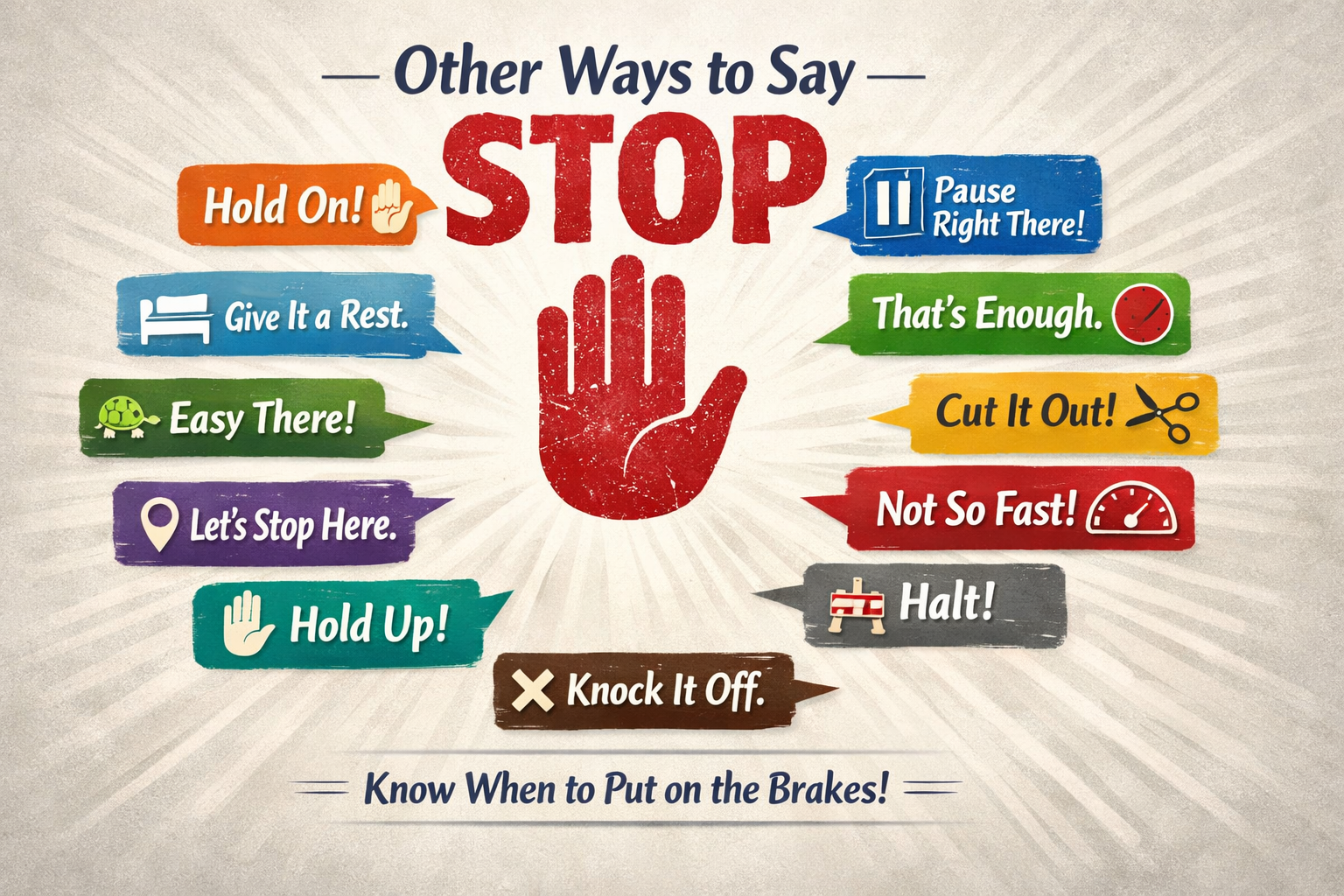
In normal conversation, people usually don’t reach for the most formal word. They say things like pause, hold up, cut it out, leave off, or even knock it off. These phrases are common in spoken English, especially when you want to sound natural rather than official.
Pause works when you want a short break, not a permanent ending. It fits a podcast recording, a game, a chat, or a task that needs a quick check. Hold up is more conversational and a little more urgent. Cut it out and knock off are common when someone needs to stop annoying behavior. Leave off sounds familiar in British English and can mean “stop doing that” in a light, everyday way.
- Pause the video for a second, I missed that part.
- Hold up, I need to check the address before we leave.
- Cut it out, you’re making the baby cry.
These are good for spoken English, texting, and quick family conversations. They’re usually better than a stiff word like cease in everyday life. If you try to sound formal here, it often feels weird.
How do you say stop in slang?
Slang changes fast, but a few forms show up often enough to be useful. People might say cut it out, knock it off, chill, or back off, depending on the situation. These are informal, and some can sound rude if the mood is already tense.
Back off is especially sharp. It works when someone is crossing a boundary, but it’s not the phrase you’d use in a polite email or a calm work meeting. Chill is softer and more playful, though it can sound dismissive if you use it badly. Real usage matters here. Tone carries a lot of weight.
Professional and Formal Options
Business writing, workplace policy, and official notices usually need a calmer, more exact word. Discontinue, suspend, terminate, and cease are common here. Stop can still work in plain instructions, but these alternatives often sound more polished when the stakes are higher.
Discontinue is a good fit for products, subscriptions, services, or procedures. Suspend suggests a temporary stop, not a final one. Terminate is stronger and often used for contracts, employment, or formal endings. Cease can sound formal or legalistic, so it’s common in policies and notices.
Here’s the practical part. If you’re writing to a customer, discontinue service or suspend access usually sounds more natural than a blunt “stop.” If you’re writing a memo, please cease can be right, but only if the tone really needs that level of seriousness. In many workplace settings, a plain sentence like “Please stop sending duplicate files” is actually the clearest choice.
And if you need to put an end to an ongoing process, the exact phrase matters. A manager might say the team will discontinue the pilot, while a lawyer might say the company will terminate the agreement. Same general idea. Very different weight.
What is a professional way to say stop?
For professional English, cease, suspend, discontinue, and terminate are the main options. If you want a softer workplace tone, pause or hold can work too, especially for meetings, reviews, or workflow changes. In a safety context, halt is common and clear.
One caution: some formal words sound natural only in writing. Desist and cease and desist are real English, but outside legal or official situations they can sound stiff or theatrical. If you’re speaking to a colleague, a simple “let’s stop here” often sounds better.
Context-Specific Ways to Say Stop
Different situations call for different verbs. A command to a driver isn’t the same as a request during a meeting. A child finishing homework isn’t the same as a machine needing an emergency shutdown. So the best choice depends on context, not just meaning.
In traffic, stop, pull over, and brake are the obvious options. In electronics, people often say switch off or shut off. In sports or games, freeze, hold it, or cut can fit the moment. In a conversation, you might break off a discussion, interrupt a pattern, or simply ask someone to check their tone before the exchange gets worse.
Sometimes the word isn’t about motion at all. It can mean stopping a behavior, a habit, or a stream of speech. That’s why “stop” shows up so often in everyday English, and why the replacement has to match the exact action. In some cases, you can even tell someone to give over when the point needs to be made quickly.
Action-Oriented Alternatives
When the job is to end an activity cleanly, end and finish are often better than “stop.” End sounds like closure. Finish suggests completion. Quit means you’re leaving something behind, and that can be a task, a game, a job, or a habit. Cut out can mean to stop an unwanted behavior, especially in spoken English.
- Finish your homework before you start the show.
- Quit checking your phone every ten seconds during dinner.
- Cut out the side comments and let her speak.
These words are not interchangeable. A teacher might say, “Finish the worksheet,” not “Stop the worksheet.” A parent might say, “Cut out the arguing,” which sounds more natural than “Cease the arguing.” A coach might say, “Quit drifting and focus on the drill.” That’s real usage. Plain and direct.
Some people also use shut down or shut off when they mean to stop a device, a system, or even a conversation. Those phrases are common in everyday English, though they feel strongest with machines, phones, and computers. You wouldn’t usually tell a friend to “shut down” their feelings. That would sound cold.
Emotional or Persuasive Phrasing
Sometimes you don’t want a hard command. You want a request. In that case, refrain, desist, and hold back can work, especially when you’re setting boundaries or asking for self-control. They sound more restrained than “stop,” and that can matter in tense moments.
Refrain from interrupting sounds measured and polite. Desist from spreading rumors sounds formal, maybe even legal. Hold back your reaction suggests self-control instead of shutdown. Used well, these phrases add a bit of distance between the speaker and the problem.
But there’s a limit. If you use a formal word in a casual setting, people may think you’re being dramatic. If you use a soft phrase in a serious moment, you may sound weak. So pick the level of force that fits the room.
How Do You Say Stop in a Fancy Way?
If by “fancy” you mean elegant, formal, or literary, then cease, desist, discontinue, and halt are the usual choices. Cease is probably the most general of the bunch. Desist feels stricter and is much more common in official notices. Halt is strong but still easy to understand. Discontinue is polished and practical.
A lot of people think fancy English means using the longest word available. It doesn’t. Real good writing sounds right for the setting. “Please cease all communication” may fit a legal or formal context. “Please stop texting me” is better in a personal text. Fancy doesn’t mean better. Natural usually wins.
If you want a more literary feel, you might also see phrases like bring to a standstill or bring to a halt. These work well in news writing, descriptions of traffic, or dramatic prose. They’re not everyday speech, but they’re clear when used with care.
Choosing Between Temporary and Permanent Stopping
The biggest difference in many cases is whether the action should stop for a moment or for good. That’s where people often get tripped up.
Pause means temporary. Suspend usually means temporary too, but it sounds more formal and institutional. Quit, end, finish, and terminate lean toward finality. Cease can go either way depending on context, though it often feels final in formal writing. Stop itself can mean either one, which is why the surrounding words matter so much.
Here’s a simple way to think about it. If the action can restart easily, use pause or suspend. If you want it over, use end, quit, or terminate. If you’re telling someone not to continue a behavior, stop, cut out, or desist may fit better.
- Pause the call while I grab my notes.
- Suspend the account until the issue is fixed.
- Terminate the trial if the customer requests a refund.
Common Mistakes and Awkward Swaps
Not every synonym fits every sentence. That’s where a lot of awkward English comes from. People hear a word that seems close and plug it in without checking the tone.
For example, cease is not the best choice in casual speech. “Cease talking right now” sounds stiff compared with “stop talking.” Desist sounds even more formal. On the other side, quit can sound too personal or too strong if you’re asking for a tiny temporary break. “Quit for a second” is odd. “Pause for a second” sounds right.
Also, be careful with verbs that normally take objects. You can say “stop the noise,” “shut off the alarm,” or “cut the music,” but you can’t swap them randomly and expect the sentence to feel normal. Native speakers pick up on those shades fast, even if they don’t explain them out loud.
One more thing. Stop by means visit briefly. It is not a synonym for stopping an action. That’s a different meaning entirely. Context matters a lot, and English is full of these little traps.
What is a better word for stop?
There isn’t one perfect replacement. The better word depends on the situation. For a temporary break, pause is better. For a formal order, halt or cease works well. For ending an activity, quit, end, or finish may be the better fit. If you want to stop behavior, desist, refrain, or cut out can sound more natural.
So, the real answer is not one word. It’s a small set of choices, each with a different job.
Practical Examples for Real Life
Examples help because they show how the word feels in motion. A dictionary definition won’t tell you whether a phrase sounds too harsh, too formal, or just plain odd. Real sentences do.
With a friend: “Hold up, I forgot my wallet.” That sounds normal. “Cease for a moment” would not.
With a child: “Cut it out and use your inside voice.” That’s common in spoken English. “Desist immediately” would sound absurd unless you were joking.
At work: “Please discontinue the duplicate reports.” This sounds tidy and professional. “Please quit the duplicate reports” sounds off.
In a safety situation: “Halt right there.” Short, firm, and clear. “Pause right there” usually sounds too soft for an urgent moment.
In a text: “Stop sending me screenshots of the same thing.” Direct, readable, and natural. You could also say, “Leave off the screenshots for now,” though that sounds more regional and less common in U.S. English.
Actionable Tips for Using These Alternatives
Practice in layers. First, notice the kind of stop you mean. Is it temporary, final, formal, emotional, or physical? Then pick the word that matches. That habit matters more than memorizing a long list.
Try this quick check before you write or speak:
- Is this a command, request, warning, or report?
- Do I want the action to pause, end, or never happen again?
- Will this sound natural to the person hearing it?
If you can answer those three questions, the right choice gets easier. You’ll also start hearing how native speakers handle these words in emails, meetings, texts, sports, parenting, and everyday chatter. That kind of attention does more than a list of antonyms ever could.
Over time, you’ll notice patterns. Stop stays useful everywhere. Pause keeps things soft. Halt adds force. Cease sounds formal. Quit ends participation. Desist sounds like a warning. And phrases like shut down, shut off, cut off, or break off cover more specific situations where plain “stop” would feel too vague.
That’s the real trick. Don’t hunt for one perfect replacement. Pick the word that fits the moment, the audience, and the level of pressure you want to apply. When you do that, your English sounds sharper, calmer, and a lot more natural.