Other Ways to Say Asked: Synonyms for Every Situation
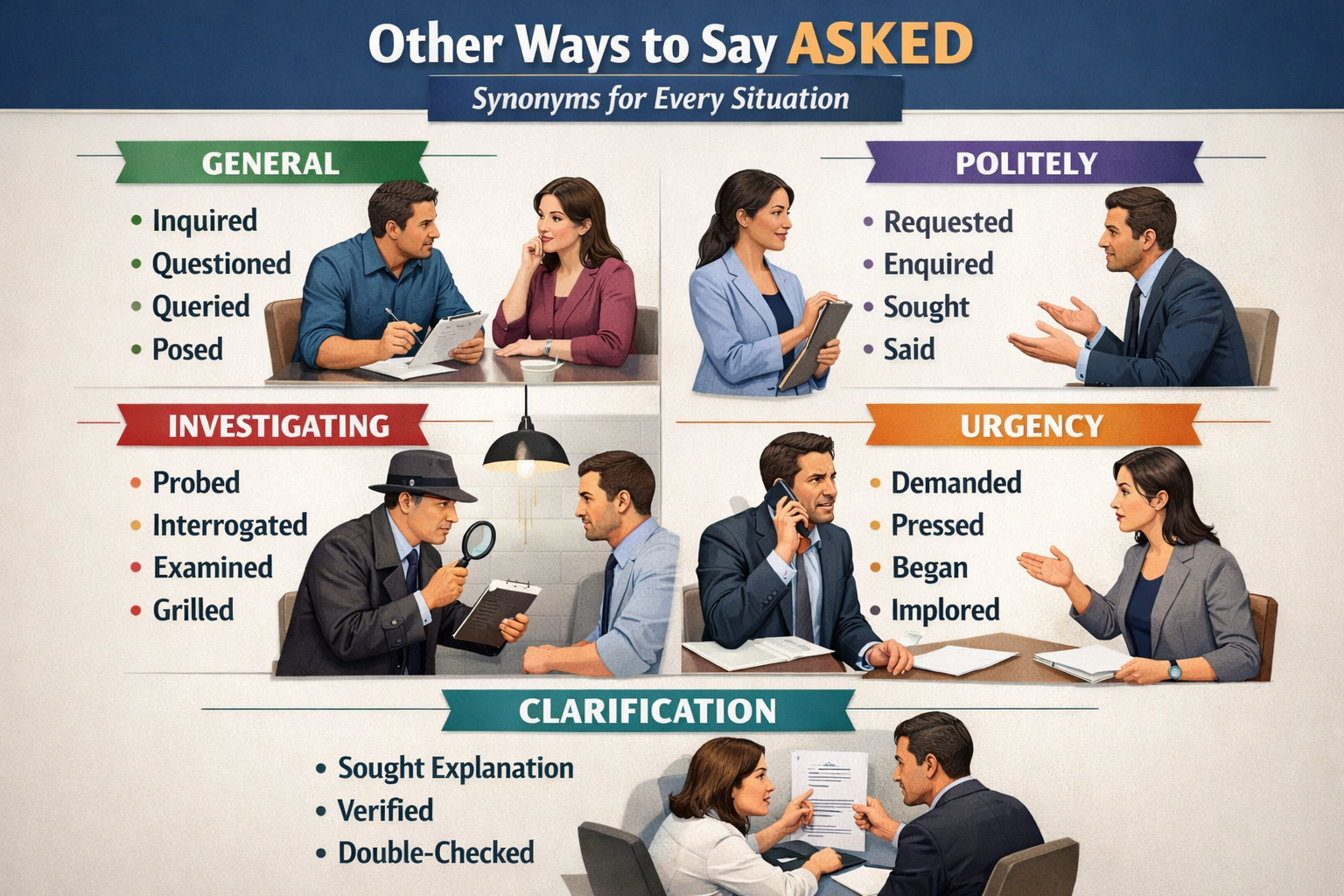
Finding other ways to say asked can make your writing clearer, sharper, and easier to read. The best replacement depends on tone and context. A formal email may call for inquired or requested. A tense scene may call for pressed, urged, or begged. And in plain conversation, sometimes questioned or replied is the better fit, depending on who is speaking and what they mean.
Here’s the short version first, since that’s usually what people want:
-
Inquired or enquired for formal questions
-
Questioned for direct, serious questioning
-
Requested for polite asks
-
Interviewed for structured questions in an official setting
-
Pressed for repeated or insistent questioning
-
Urged, begged, or appealed for emotional requests
-
Invited for asking someone to do something or take part
-
Called or asked for in some everyday sentence patterns
If you’re looking for Synonyms & Similar Words, that’s the main idea here: pick the word that keeps the meaning intact, then match the tone. A lot of “other ways to say asked” lists blur that line and treat every verb like a perfect swap. They’re not.
For example, Conversating vs. Conversing is a good reminder that natural-sounding choices matter more than fancy ones. The same goes here. A neat synonym that changes the meaning is worse than the plain word asked.
What is a better word for “asked”?
The best answer is usually one of these: inquired, questioned, requested, or interviewed. Those are the closest everyday replacements when you want to sound a little more specific than asked.
But the right word changes with the sentence. If you wrote, “She asked about the schedule,” you could usually say, “She inquired about the schedule” in a formal setting. If you wrote, “The detective asked the witness about the phone call,” then “questioned” fits better because the scene suggests pressure and a serious exchange.
Here’s a quick way to sort the most common options:
|
Word |
Best for |
Tone |
Example |
|---|---|---|---|
|
inquired |
formal questions, polite business writing |
polite, professional |
She inquired about the meeting time. |
|
questioned |
direct or serious questioning |
firm, neutral, sometimes tense |
The officer questioned the driver. |
|
requested |
a polite ask for action or information |
formal, courteous |
He requested an extra copy. |
|
interviewed |
planned or structured questions |
formal, task-based |
They interviewed five candidates. |
|
pressed |
repeated or persistent questioning |
insistent, often tense |
She pressed him for details. |
How do you say “asked” in a formal way?
Use inquired, requested, consulted, or interviewed, depending on the sentence. If you want a polished tone for business writing, inquired is often the safest choice. If the sentence is about getting something, requested works better. If the action involves a set question process, interviewed is the clearest.
Compare these examples:
-
“She asked for a copy of the report.” becomes “She requested a copy of the report.”
-
“The client asked about the timeline.” becomes “The client inquired about the timeline.”
-
“The recruiter asked the candidate several questions.” becomes “The recruiter interviewed the candidate.”
That last one matters. Interviewed isn’t a casual synonym for every use of asked. It works when the questioning is planned, formal, or repeated. It does not fit a one-off question at the coffee counter.
Direct alternatives by context
If you’re editing a sentence, context usually tells you which substitute is right. A single verb rarely fits every version of “asked.” Here are the most useful groups.
Polite and professional requests
Use requested, inquired, or asked for when the sentence is calm and respectful. These words work well in emails, client messages, and reports.
-
“She asked for an update.” becomes “She requested an update.”
-
“He asked about the invoice.” becomes “He inquired about the invoice.”
-
“They asked to meet on Friday.” becomes “They requested to meet on Friday.”
Why these fit: they keep the same meaning without sounding too sharp. If you want a little more formality, inquired is usually better than plain asked. If you want the sentence to focus on the thing being wanted, requested reads more naturally.
Direct questioning or investigation
Use questioned, interviewed, or pressed when the asking is formal, repeated, or part of an investigation. These words carry more weight than asked.
-
“The police asked the witness again.” becomes “The police questioned the witness again.”
-
“The journalist asked the minister about the leak.” becomes “The journalist interviewed the minister about the leak.”
-
“She asked him for the truth.” becomes “She pressed him for the truth.”
Notice the difference. Questioned is broad and fairly neutral. Pressed suggests persistence. It’s the right word when someone keeps pushing for an answer. If you use it in a sentence that’s too mild, it can make the scene sound harsher than you meant.
Emotional or insistent requests
Use urged, begged, or appealed when the speaker wants something badly. These aren’t plain substitutes for asked, but they fit when the sentence carries emotion or urgency.
-
“She asked him to stay.” becomes “She begged him to stay.”
-
“The doctor asked the patient to rest.” becomes “The doctor urged the patient to rest.”
-
“The charity asked for donations.” becomes “The charity appealed for donations.”
These words change the force of the sentence. Begged sounds desperate. Urged sounds firm but not frantic. Appealed sounds public, persuasive, and sometimes emotional. In a news story, that difference matters a lot. In fiction, it shapes the whole scene.
Everyday synonyms and similar words that actually sound natural
For casual writing, the most useful Synonyms are often the plainest ones. Not every sentence needs a fancy verb. Sometimes asked is still the best choice, especially in dialogue. But if you want variety, these usually work well:
-
questioned for a direct ask
-
requested for polite action
-
inquired for a formal tone
-
wondered only when the subject is thinking, not speaking
-
called in some patterns, like calling for help or calling out a request
That fifth one needs care. “He called for help” is fine. “She called about the schedule” can work too, but it means she phoned, not that she phrased a question in a more elegant way. So don’t treat it as a direct swap every time.
Here’s a better sentence-level comparison, using the same idea in three ways:
-
“She asked for directions.”
-
“She requested directions.”
-
“She inquired about the nearest bus stop.”
All three are understandable. The first is plain. The second is tidy and polite. The third is more formal and a bit old-fashioned, which may be exactly what you want in business copy or narrative prose.
What is a better word for asking?
If you mean the verb form, the answer depends on what the asking does. Requesting works for polite asks. Inquiring works for information-seeking. Questioning works for direct or repeated questioning. Pressing works when someone keeps pushing for an answer.
If the sentence is about the act in general, try to rewrite the whole line instead of swapping one word. For example:
-
“His asking for help was polite.” becomes “His request for help was polite.”
-
“Her asking about the delay was reasonable.” becomes “Her inquiry about the delay was reasonable.”
-
“The officers kept asking about the missing keys.” becomes “The officers kept questioning him about the missing keys.”
That kind of rewrite usually sounds smoother than forcing a single synonym into place.
Creative writing: choosing the right shade
In fiction, the best replacement for asked often depends on who has the power in the scene. A nervous character might ask or plead. A stronger character might press or demand. A character trying to sound calm might inquire.
Here are some real-feeling swaps:
-
“He asked her to leave.” becomes “He demanded that she leave.” if the scene is hostile.
-
“She asked if he was all right.” becomes “She inquired if he was all right.” if the voice is formal or restrained.
-
“He asked for one more chance.” becomes “He pleaded for one more chance.” if the moment is emotional.
Watch the difference between asked and invited. They overlap only in certain patterns. “She invited him to join the table” is fine because it’s about offering participation, not simply asking a question. That word doesn’t replace every use of asked, but in the right sentence it sounds natural and warm.
Also, if a line includes a strong speaker and a weak reply, the verb can do a lot of work. A character might ask, reply, press, or hesitate in a few words. That tiny choice changes the pace.
Dialogue choices that sound natural
Dialogue needs rhythm more than polish. In most cases, asked is still better than a rare synonym that draws attention to itself. But if you’re repeating the same tag too often, a few edits can help.
-
“What time is it?” she asked.
-
“What time is it?” she said, glancing at the clock.
-
“What time is it?” she inquired, trying to sound calm.
The second line is often the strongest because it avoids an unnecessary tag. The third works only if the voice is formal or slightly stiff. So, don’t replace asked just to avoid repetition. Replace it because the scene needs a different feel.
Synonyms & Antonyms: what not to use
People often look for Synonyms & Antonyms together, but antonyms matter here because they help you avoid bad substitutions. The opposite of asking is not always one clean word. It might be answered, replied, or simply stayed silent, depending on the sentence.
That’s why replied is useful in this topic, even though it isn’t a synonym for asked. It shows the other side of the exchange. If one person asks and the other replies, you’ve got a natural conversation. If you write, “She asked and he replied,” the pairing feels complete.
Just as important, a few words that sound related are not true substitutes. Wondered usually means someone thought about something privately. Examined means to inspect closely. Neither one directly replaces asked in ordinary writing. That’s a common mistake in synonym lists, and it creates clumsy sentences.
Use this simple rule: if the verb changes the action from speaking to thinking, inspecting, or accusing, it’s probably not a direct replacement.
How do you say “ask” in a fancy way?
If you want a fancier version of ask, start with inquire. It’s the cleanest formal alternative. If the sentence is about seeking something, request sounds more polished. For official or structured situations, interview or query may fit, depending on the meaning.
But fancy doesn’t always mean better. In an ordinary sentence, “She inquired whether the train was delayed” can sound stiff. “She asked whether the train was delayed” often reads better. So pick the fancier word only when the tone needs it.
A few examples help show the range:
-
Plain: “He asked for more water.”
-
Polished: “He requested more water.”
-
Formal: “He inquired about additional water.”
The third one sounds more ceremonious, but it also sounds less natural. That’s fine in some legal, academic, or historical writing. It’s not great in everyday conversation.
Practical editing notes from real writing
When I’m editing a sentence, I usually check three things. First, does the replacement keep the same action? Second, does it match the speaker’s tone? Third, does it sound like something a real person would say? If the answer to any of those is no, I leave asked alone.
Here are a few examples of the kind of choice an editor actually makes:
In an email: “You asked about the invoice” can become “You inquired about the invoice” if the message is formal, but that change may sound too stiff in a friendly note. So, I’d usually keep asked or switch to requested only if the sentence needs more formality.
In reported speech: “The manager asked for more time” often reads better as “The manager requested more time.” That’s because the noun phrase after the verb is tight and professional.
In a tense scene: “He asked for the file” may feel too soft if the character is under pressure. “He demanded the file” or “He pressed for the file” is stronger, but it changes the mood. That’s the trade-off.
Quick rules for choosing the right replacement
Use these as a fast filter before you swap a word in your draft:
-
Use inquired for polite, formal questions.
-
Use requested for asking for an object, action, or favor.
-
Use questioned for direct or serious questioning.
-
Use interviewed for planned question-and-answer situations.
-
Use pressed when the speaker keeps pushing for an answer.
-
Use urged when the ask is firm and meant to persuade.
-
Use begged when the request is emotional or desperate.
-
Use appealed for public or heartfelt requests, especially groups or causes.
And if none of those fits cleanly, don’t force it. Plain asked is often the strongest choice because it’s invisible, natural, and easy to follow. Good writing doesn’t always need a fancier verb. It needs the right one.
That’s also why a search for “other ways to say asked” should give you direct options first, then the limits of each one. A useful guide doesn’t just list words. It tells you which ones behave like real substitutes and which ones only work in special cases.
As a final note, editors and style guides sometimes differ on preference, and even a date like May 27, 2026 might be written differently depending on region and house style. Word choice works the same way. There isn’t one perfect answer for every sentence, just a better fit for the line in front of you.
If you’re comparing source material, you may even see entries in tools like merriam-webster under Synonyms & Antonyms, but the dictionary won’t make the sentence for you. You still have to decide what the speaker is doing, what the tone is, and how formal the line should sound. That’s the real job.
So the short answer is simple. If you want other ways to say asked, start with inquired, questioned, requested, interviewed, pressed, urged, begged, and appealed. Then check the sentence. If it still means the same thing, you’re good. If not, go back to plain asked.