Other Ways to Say Old: Fresh Synonyms for People, Objects & Writing
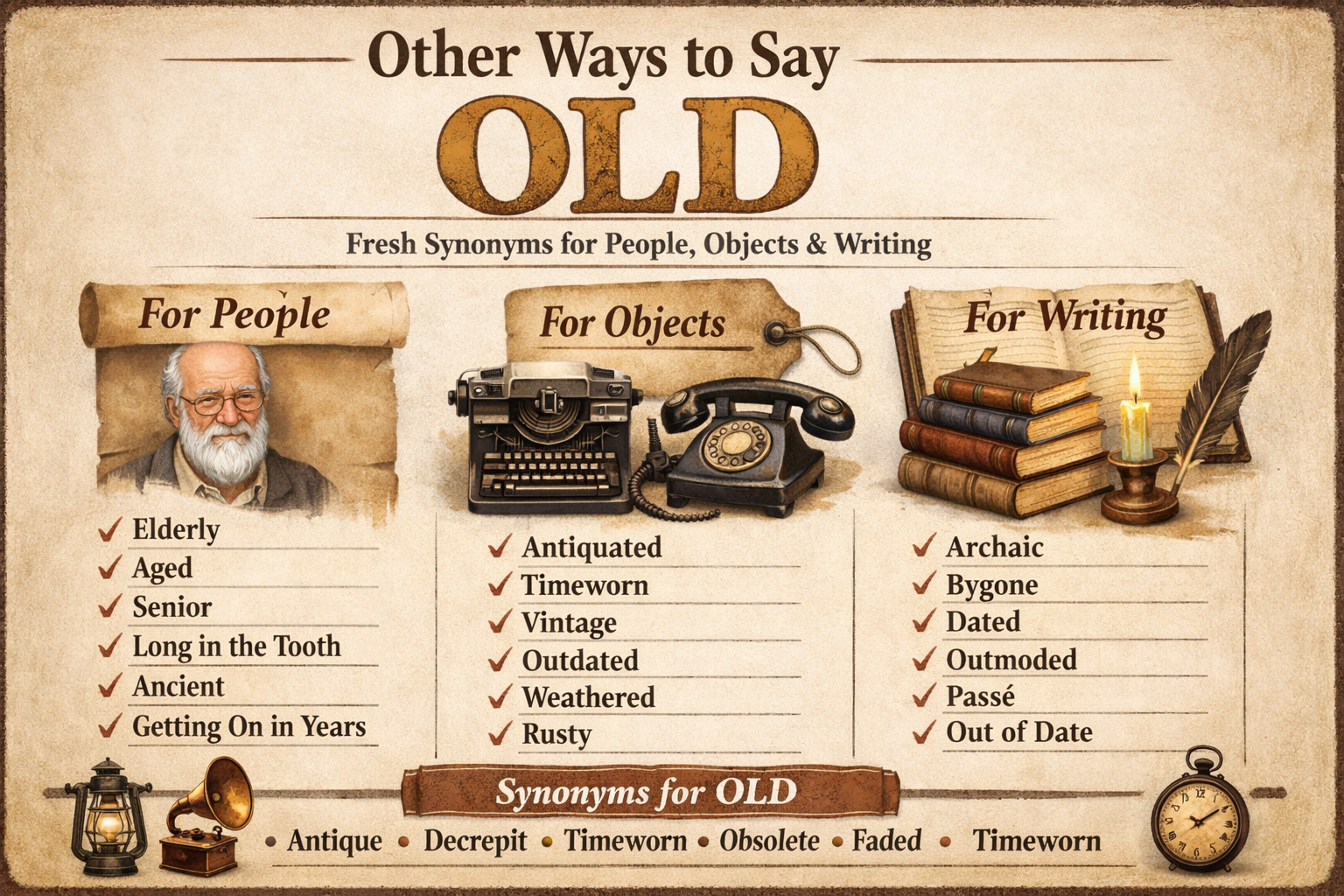
If you need other ways to say old, the safest swaps are aged, older, elderly, antique, vintage, ancient, old-fashioned, and obsolete, depending on what you’re describing.
Quick answers: better words for old
There isn’t one perfect replacement. The right word depends on whether you mean a person, an object, an idea, or a style that belongs to a former period. A sentence about a house that’s been around for decades usually sounds better with aged, historic, timeworn, or century-old. A person is usually better described as older, elderly, senior, or venerable. And if something no longer works in the present day, obsolete, antiquated, or outmoded may fit better than plain old.
Sometimes old is still the clearest word. It’s short, direct, and neutral. If you’re writing a label, a note, or a quick conversation, keeping it can sound more natural than reaching for a fancier synonym.
What’s a better word for old person?
For a person, tone matters a lot. Elderly is respectful in many contexts, though it can feel formal. Older is the safest everyday choice because it avoids sounding blunt. Senior works in official settings, while retired can describe life stage without commenting on age directly.
Some words are best avoided unless you really mean them. Senile is a medical or pejorative term linked to mental decline, so it should not be used as a casual synonym for old. Oldish can sound vague and a little careless. And if you want a warmer tone, venerable suggests dignity and long experience rather than age alone.
Respectful choices for people
-
Older is the simplest and most neutral option. “An older neighbor helped us move the boxes.”
-
Elderly works in polite, formal, or caregiving language. “The elderly resident asked for assistance.”
-
Senior suits documents, services, and community programs. “Senior discounts apply after 62.”
-
Retired describes someone who has left full-time work, which is often more exact than calling them old. “The retired teacher still tutors on weekends.”
-
Venerable adds respect, usually for someone admired over a long period. “A venerable judge addressed the room.”
How to avoid sounding rude
If your sentence sounds sharp, the problem is usually the context, not the age term itself. “Old man” can sound dismissive, especially in print. “Older man” softens it. “Elderly man” is gentler still, though it may feel formal. If you want a friendlier tone, use a phrase that gives the person a role or identity instead of only an age label, like “the resident historian,” “a longtime coach,” or “a retired mechanic.”
What is a better word for old things?
For objects, the best replacement depends on condition. A sofa that’s simply been around for years might be worn or aged. A lamp from another era might be vintage or antique. A system that no longer belongs in a current workflow is probably obsolete or outmoded. And if something looks old but isn’t valuable, worn-out or rusty may be the honest choice.
Here’s the thing: “old” can mean different things in object descriptions. It can mean physically aged, historically significant, unfashionable, or simply not new. Use the word that matches the problem you’re describing.
|
What you mean |
Better word |
Example |
|---|---|---|
|
Has age, but still useful |
aged, used, worn |
an aged leather jacket |
|
Has style or collectible value |
vintage, antique, classic |
a vintage radio |
|
No longer current |
obsolete, antiquated, outmoded |
obsolete software |
|
Looks old and tired |
worn-out, timeworn, shabby |
a worn-out carpet |
|
From a past period |
bygone, traditional, classic |
a bygone fashion trend |
Objects, style, and condition
-
Aged is a safe choice when age is part of the object’s character. “An aged wooden table sat near the window.”
-
Vintage suggests classic appeal, not mere age. “She wore a vintage coat from the 1970s.”
-
Antique usually means older and collectible, often with value attached. “The shop displayed an antique clock.”
-
Classic often sounds better than old when something still feels admired or stylish. “He bought a classic roadster.”
-
Worn-out works when the item is past its best. “My shoes are worn-out after the trip.”
-
Rusty fits metal, tools, or skills that have deteriorated. “The rusty bike chain needs oil.”
Best alternatives by context
A good editor usually thinks in categories, not just synonyms. The word you choose has to match the sentence around it. “Old house” can become “aged house,” “historic house,” “timeworn house,” “old-fashioned house,” or even “century-old house,” and each version tells the reader something different.
People, objects, ideas, and style
-
People: older, elderly, senior, retired, venerable, seasoned.
-
Objects: aged, antique, vintage, timeworn, worn, classic.
-
Ideas or systems: outdated, obsolete, antiquated, outmoded, old-school.
-
Style or tradition: traditional, old-time, old-fashioned, old-school.
These groups overlap, but not enough to ignore the differences. A traditional recipe is not the same as an antiquated recipe. Traditional usually means established and still respected. Antiquated usually means out of date. One sounds steady. The other sounds behind the times.
Common replacements you’ll actually use
Some synonyms show up all the time because they solve real writing problems. These are the ones I’d reach for first in editing.
Aged, older, and ancient
Aged is one of the cleanest replacements for old when you want to describe a thing without sounding casual or sloppy. It works especially well with materials, buildings, wine, cheese, and skin or hair in a descriptive passage. “An aged oak door creaked open.” That sounds more considered than “an old oak door” and less decorative than “an antique oak door.”
Older is the best everyday option for people. It’s polite, plain, and hard to misuse. “My older brother” sounds normal in almost any setting. By contrast, “elderly brother” feels stiff and usually odd unless the age gap is huge or the sentence has a formal purpose.
Ancient is stronger. It suggests extreme age, sometimes to the point of exaggeration. Use it when you want scale. “An ancient stone wall” paints a far different picture from “an old stone wall.”
-
“The old bridge needs repairs.” becomes “The aged bridge needs repairs.”
-
“My old friend called.” becomes “My older friend called.”
-
“The old ruins sat on the hill.” becomes “The ancient ruins sat on the hill.”
Vintage, classic, and antique
Vintage usually carries charm. It can mean genuinely old, but it often points to style, not damage. That’s why “vintage dress” sounds appealing, while “old dress” can sound forgettable. In product descriptions, vintage is often the nicer word when the item has personality.
Classic is useful when something has lasting respect. A classic car, classic coat, or classic album usually sounds admired and current enough to be desired now. It doesn’t just survive time. It keeps earning attention.
Antique is more specific. It often implies age, value, and collectability. A piece can be old without being antique, and that distinction matters. A flea-market chair may be old and scratched. An antique chair suggests history, craftsmanship, and possibly a price tag to match.
Old-fashioned, old-style, and time-honored: style words with different shades
These three are easy to mix up, but they don’t mean the same thing.
Old-fashioned usually means not modern in style or taste. It can be affectionate or critical. A dress might be old-fashioned in a charming way. A business process might be old-fashioned in a frustrating one. Old-style often sounds cooler and more informal. It can suggest loyalty to an earlier method or attitude. Time-honored feels nostalgic, especially in phrases like time-honored music or time-honored remedies.
If you need a term for something from another era that still has charm, these words can work well. If you need to say something is simply behind the times, they may not be enough.
-
Old-fashioned: “She prefers old-fashioned letter writing.”
-
Old-style: “He likes old-style jazz and vinyl records.”
-
Time-honored: “The festival featured time-honored fiddle music.”
Words for things that no longer fit the present
Sometimes “old” doesn’t mean aged or vintage at all. It means useless, behind the times, or no longer accepted. That’s where words like obsolete, outmoded, antiquated, and antediluvian come in. These are stronger, and they often carry judgment.
Obsolete is probably the most useful of the group. It’s clear, formal, and common in tech, business, and policy writing. A format, tool, or law can become obsolete when a newer one replaces it. Outmoded is similar but slightly softer, and it often points to style or practice. Antiquated suggests something old enough to feel clumsy in the present. Antediluvian is even more intense and usually sounds humorous or grandiose. Use it carefully. It’s the kind of word that can seem witty in a review and ridiculous in a memo.
A few examples make the difference easier to see:
-
“The old software crashed often.” becomes “The obsolete software crashed often.”
-
“His old ideas about work annoyed the team.” becomes “His antiquated ideas about work annoyed the team.”
-
“The old rules slowed the process.” becomes “The outmoded rules slowed the process.”
-
“The old building code was hard to defend.” becomes “The antediluvian building code was hard to defend.”
How to say old without sounding rude
What’s a polite way to say “old”? Usually, you soften the noun or shift the focus. Say “older adult” instead of “old person.” Say “well-established” instead of “old company.” Say “timeworn” or “historic” instead of “old house” if you want a respectful, descriptive feel.
The trick is not to hide age completely. It’s to describe it without making the phrase feel blunt. In good writing, the adjective should carry the tone you want. “Aged professor” sounds formal. “Venerable professor” sounds admiring. “Old professor” sounds plain, and depending on context, it may sound careless too.
Before-and-after rewrites
-
Before: The old house needed work.
After: The timeworn house needed serious repair, but the original woodwork was still intact. -
Before: He uses old methods at work.
After: He still relies on old-style methods at work, which annoy some coworkers and impress others. -
Before: They bought an old car.
After: They bought a classic car with enough character to turn heads. -
Before: The old policy hurts customers.
After: The obsolete policy hurts customers and should probably be retired.
When old is still the best word
Plain old can still win. It’s short. It’s natural. It doesn’t overdescribe. If you’re writing a quick note, a headline with limited space, or a sentence where age is obvious and unimportant, old is usually better than a pretentious substitute. “Old house” is often fine. “Old friend” can feel warmer than “aged friend,” which would sound strange. “Old news” is clearer than “outmoded news,” and that’s because some phrases have already settled into the language.
In other words, don’t swap words just to avoid repetition. Swap them when the new one gives the reader more useful information.
Words that imply age without saying it outright
Not every replacement needs to point directly at age. Sometimes you can suggest the idea through a more exact description. A house can be historic, a device can be dated, a habit can be traditional, and a neighborhood can feel bygone. Those words do more than label age. They tell the reader what the age means.
Former and previous are especially handy when you’re talking about positions, roles, or versions. A former mayor is not an old mayor. A previous edition is not necessarily aged in any emotional sense. These words avoid confusion when “old” would sound clumsy or too vague.
-
Former: “Her former manager wrote the recommendation.”
-
Previous: “Please review the previous draft.”
-
Historic: “They stayed in a historic inn downtown.”
-
Bygone: “The museum collected photos from a bygone era.”
Other ways to say old in formal and creative writing
Formal writing usually needs precision more than flair. Creative writing, on the other hand, can take a little more color. A report might call a policy obsolete, a building aged, or a program outdated. A novel might call the same house timeworn, venerable, or even primeval if the mood is dark enough.
Use this difference to your advantage. If you’re writing a legal brief, “old-fashioned” may sound too loose, and “venerable” may sound too warm. If you’re writing fiction, “obsolete” can feel flat where “antiquated” gives the sentence some bite. None of these words is automatically better. The sentence decides.
Style guide cheat sheet
-
Formal/professional: older, aged, former, previous, obsolete, longstanding.
-
Neutral everyday: old, older, aged, used, worn.
-
Positive or admiring: vintage, classic, venerable, traditional.
-
Negative or critical: outdated, antiquated, outmoded, worn-out, rusty.
One last note. A word can sound old in one sentence and perfectly normal in another. “Aged cheese” works. “Aged man” usually doesn’t. “Old friend” feels natural. “Old colleague” often feels less so unless you mean long acquaintance. That’s why good word choice is less about memorizing synonyms and more about hearing the sentence in your head before you publish it.