Other Ways to Say Appreciate: Professional & Casual Alternatives
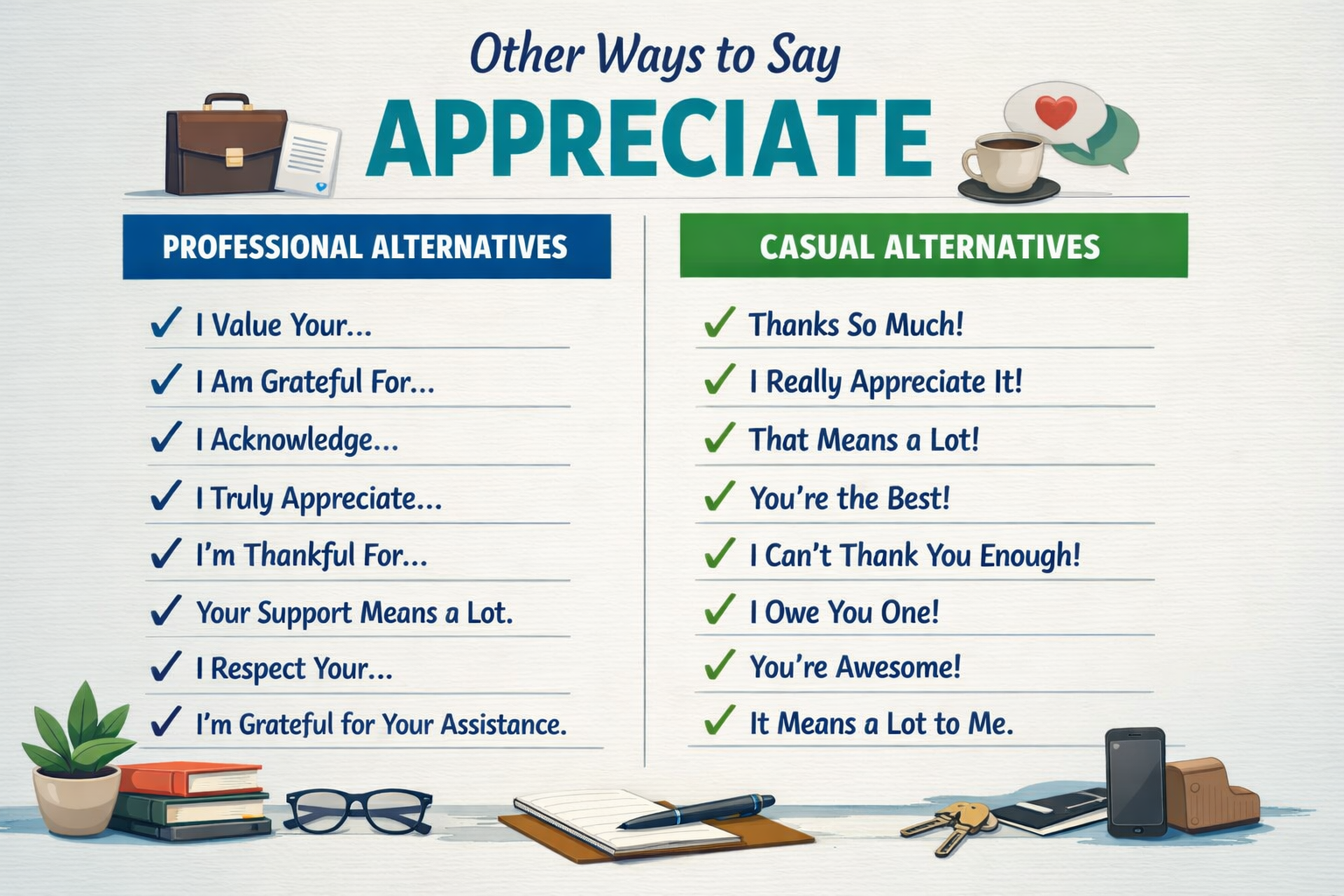
If you’re looking for other ways to say appreciate, start with the most useful substitutes right away: I value this, I’m grateful for, I truly appreciate, I’m thankful for, I recognize your help, and I’m grateful to you. Use the warmer options with friends, the more formal ones in English for work emails, and the simplest ones when you just need to sound natural.
|
Phrase |
Tone |
Best use |
Quick example |
|---|---|---|---|
|
I value this |
Professional, steady |
Feedback, teamwork, client conversations |
I value this and I’ll keep it in mind for the next draft. |
|
I’m grateful for |
Warm, sincere |
Notes, texts, thank-you messages |
I’m grateful for the time you spent helping me review this. |
|
I truly appreciate |
Polite, flexible |
Email, meetings, formal thanks |
I truly appreciate your quick response. |
|
I’m thankful for |
Friendly, simple |
Everyday speech, personal messages |
I’m thankful for your support during the move. |
|
I recognize your help |
Professional, clear |
Workplace messages, reviews, acknowledgments |
I recognize your help in getting this over the line. |
|
I value this |
Respectful, direct |
When you want to show appreciation without sounding gushy |
I value this advice, and I’ll use it in the final version. |
Expressing gratitude can sound plain if you use the same phrase every time. The good news is that English gives you a lot of clean alternatives, and the right one depends on tone, closeness, and setting. A thank-you note to a manager shouldn’t sound like a text to a friend, and a quick reply to a favor shouldn’t read like a formal speech.
Why Other Ways to Say Appreciate Matter
People notice wording fast. In emails, meetings, and short messages, repeated language can make your thanks feel automatic, even if you mean it. Fresh phrasing helps you show gratitude without sounding stiff or copied from a template.
There’s also a small but real difference between gratitude and recognition. Sometimes you want to express appreciation for help. Other times, you want to express appreciation for effort, patience, or a thoughtful gesture. And sometimes the better move is to admire the work, which carries a slightly different tone from simple thanks. A strong word choice helps you communicate the right level of admiration, esteem, or respect.
Be careful not to confuse appreciate with appraise or apprise in formal writing.
What Is a Better Word for “Appreciate”?
There isn’t just one. The better word depends on what you mean by appreciate. If you mean “I’m thankful,” then grateful or thankful works well. If you mean “I understand the value of this,” then value, recognize, or respect may fit better. If you want something slightly more formal, acknowledge and honor can work in the right context.
Here’s the useful part. “Appreciate” in English can mean three different things: to be thankful, to value something, or to increase in worth. This article focuses on the first two. That’s why “I appreciate your help” and “I value your input” are related, but not identical.
Professional Alternatives to Appreciate
In business settings, the best phrase is usually the one that sounds calm and specific. You don’t need to overdo it. In fact, a short line often feels more genuine than a big polished paragraph full of praise.
How do I say “I appreciate you professionally”?
If you want to sound professional, stick with phrases that are clear, respectful, and not too intimate. A simple email to a manager might say, “I appreciate your guidance on this project,” or “I value your feedback on the draft.” In a client note, “I recognize your support” or “I’m thankful for your time” can sound polished without feeling cold.
A good rule: the more formal the relationship, the less slang you should use. “You rock” might be fine in a team chat. It can feel out of place in a message to a senior executive.
Workplace phrases with the right tone
-
I value your input. Best for meetings, reviews, and planning sessions where you want to show respect for someone’s ideas.
-
I appreciate your time. Good in emails, interviews, and appointment follow-ups when the main point is courtesy.
-
I recognize your effort. Useful when you want to acknowledge work, even if the result wasn’t perfect.
-
I’m grateful for your support. Warm but still professional, so it works well in team messages and client notes.
-
Your help made a real difference. Best when you want the message to feel specific, not generic.
These phrases are strong because they do more than say thanks. They name the action, which makes the message feel real. If a coworker stayed late to fix a problem, “I value the time you put into this” sounds more precise than a plain “appreciate it.”
What Can I Say Instead of “Appreciate It”?
This is the phrase people search for most often, because “appreciate it” shows up in quick replies all the time. If you want a more natural option, choose based on closeness and formality.
For a fast text, “Thanks, I’m grateful” or “That means a lot” usually works. For email, “I appreciate your help” or “Thanks for taking care of this” feels smoother. If you want to sound more direct, “I value this” or “I recognize that effort” can carry more weight.
Simple swaps for quick replies
-
Thanks, I appreciate it. Neutral and safe. Good for almost any everyday message.
-
I’m grateful for that. Slightly warmer, and it sounds more personal.
-
I value this. Short and thoughtful, especially when you want to show that the help really mattered.
-
That helps a lot, thank you. Friendly and practical, ideal for texts and chat messages.
Real-world example: if a coworker sends over a file five minutes before a deadline, “That helps a lot, thank you” sounds natural. If your neighbor brings in your package, “I’m grateful for that” feels warmer. Small differences. Big effect.
Casual Ways to Say Appreciate in Daily Life
For friends, siblings, partners, and close coworkers, you can sound more relaxed. The trick is to keep it warm without getting so casual that it turns into filler. Some phrases feel easy and sincere. Others feel a little too slick.
Everyday conversation choices
-
I’m thankful for your help. Friendly and sincere, great for favors, rides, and everyday support.
-
I’m grateful for you. More personal, so it works best with people you know well.
-
That means a lot to me. Good when the kindness matters more than the task itself.
-
I owe you one. Casual and playful, but best among friends or people who know your style.
Here’s a subtle difference worth keeping in mind. “I’m thankful for your help” focuses on the action. “I’m grateful for you” focuses on the person. That second one can feel lovely in a text to a close friend, but a bit too intimate in a workplace setting.
Playful phrases that still sound natural
-
You rock. Best in friendly settings, team chats, or texts where the tone is already casual.
-
Big thanks. Short and upbeat, useful when you want to keep things light.
-
You saved me. Great when someone stepped in at the last minute and made your life easier.
-
I can’t thank you enough. A little stronger, and it works when the favor was genuinely important.
Real-world context helps here. “You rock” is something you’d text after a friend helps with a last-minute pickup. “I can’t thank you enough” fits better in a voice note after someone spends an afternoon helping you move. Same idea, different weight.
Alternatives for Notes, Emails, and Written Messages
Written gratitude gives you a little more room to sound thoughtful. A note, card, or email can include a phrase that feels a bit richer than a quick reply, but it still shouldn’t sound like a speech.
If you’re writing to someone who helped you at work, clarity matters most. If you’re writing to family or a close friend, warmth usually matters more. And if you’re posting online, shorter is often better because the message has to read well at a glance.
One good test is this: if the line would sound strange out loud, it probably needs trimming.
Handwritten notes and thank-you messages
-
Your kindness meant a great deal. Best for personal notes after support during a hard time.
-
I hold your help in high regard. Formal and respectful, though a little old-fashioned.
-
I admire the way you handled that. Works when you want to mix thanks with genuine respect.
-
Thank you for the time you gave me. Polite and specific, which makes it useful in letters and follow-up emails. Much appreciated.
That phrase “the time” deserves attention because it often changes the feel of a message. Thanks for the time they spent on your request is usually more concrete than saying thanks in a broad way. It shows you noticed the effort, not just the result.
Phrases to Avoid by Context
Some phrases are perfectly fine in one place and awkward in another. This is where a lot of people miss. They pick a phrase that sounds friendly, but it lands too flat, too slangy, or too personal.
You rock is too informal for a formal client email. I owe you one can sound vague or even slightly transactional in a professional setting, especially if the favor was serious. Big thanks may feel too short if you’re trying to express real appreciation after major help. And “I’m grateful for you” can sound too intimate unless the relationship is already close.
There’s also a smaller pitfall. Some phrases can sound insincere if they’re paired with a rushed tone or dropped into a message that already sounds cold. If you write only “appreciate it” in a formal email, it can feel abrupt. Add a reason, a detail, or a next step, and it reads much better.
A quick formality guide
|
Context |
Safe choice |
Phrase to avoid |
Why |
|---|---|---|---|
|
Manager email |
I appreciate your guidance |
You rock |
Too slangy for a workplace message |
|
Friend text |
I owe you one |
I hold your help in high regard |
Too stiff for casual conversation |
|
Client note |
I value your time |
Big thanks |
Too thin if you need a polished tone |
|
Close family message |
I’m grateful for you |
I recognize your effort |
Too formal and distant |
How to Choose the Right Phrase Fast
Pick the phrase by thinking about three things: relationship, setting, and level of feeling. If it’s work-related, lean toward value, recognize, or appreciate. If it’s personal, grateful, thankful, or means a lot usually feels right. If the gesture was small, keep your wording simple. If it was a big favor, say more.
Here’s a simple way to sort it out:
-
Professional and polite: I appreciate your time, I value your input, I recognize your support.
-
Warm and personal: I’m grateful for you, I’m thankful for your help, that means a lot to me.
-
Casual and quick: thanks, big thanks, you rock, I owe you one.
If you want to be extra precise, match the sentence to the action. Praise the effort if the person spent time. Thank them for the help if they solved a problem. Recognize the support if you’re writing in a team setting. And if the person went above and beyond, don’t be shy about saying it plainly.
That’s really the point. The best alternative to appreciate is the one that sounds like you, fits the relationship, and tells the other person exactly what you noticed.