Other ways to say “In Conclusion”: how to end essays, reports & blogs
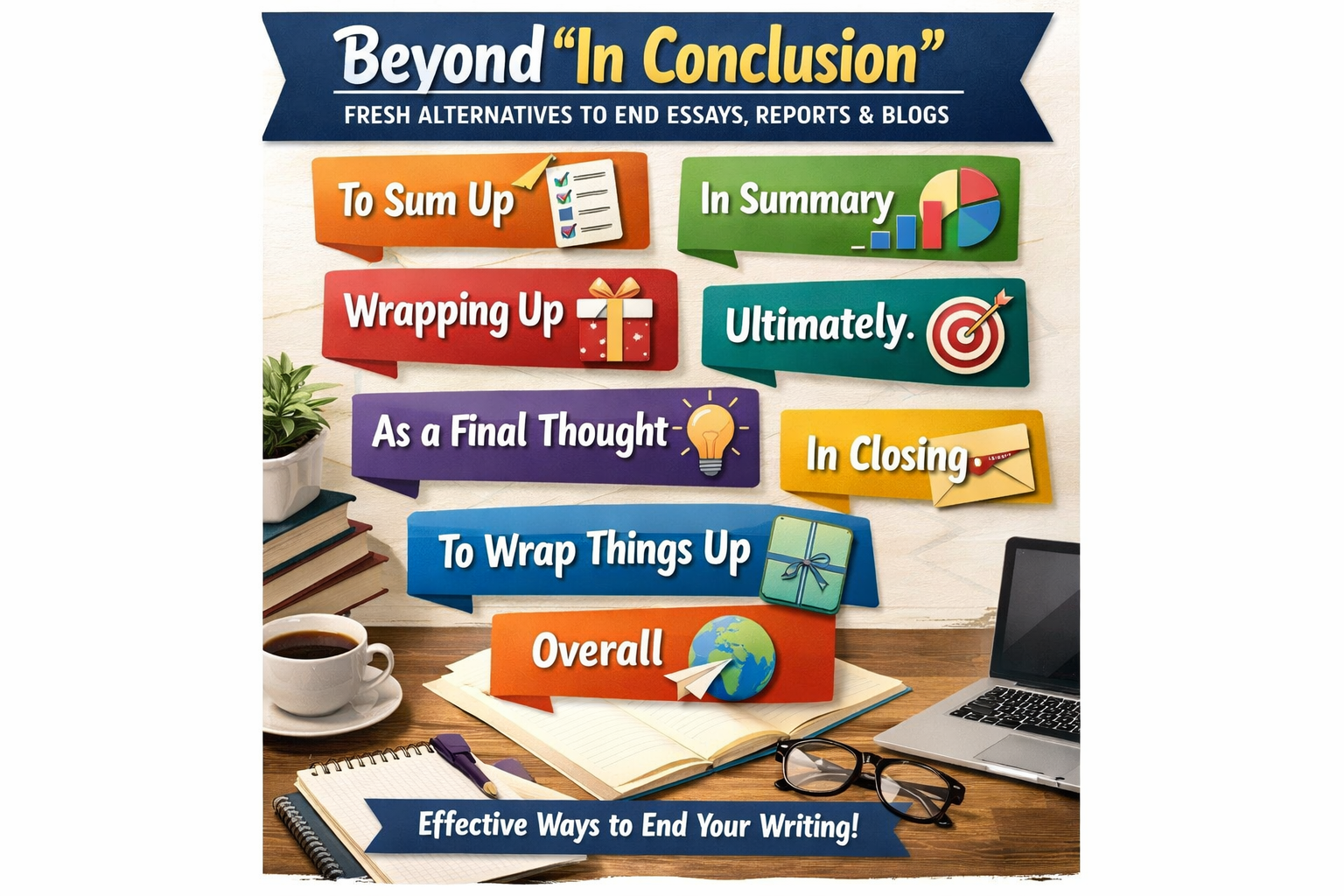
If you’re looking for other ways to say in conclusion, the fastest answer is simple: pick a wording that matches the tone of the piece. A formal paper needs different wording than a blog post, speech, or presentation, and the best choice usually depends on how direct, polished, or conversational you want to sound.
Quick alternatives to “in conclusion”
|
Phrase |
Tone |
Best use |
|---|---|---|
|
In summary |
Neutral, clear |
Essays, reports, professional writing |
|
To sum up |
Simple, direct |
Blog posts, school writing, everyday summaries |
|
In closing |
Polite, formal |
Emails, speeches, public remarks |
|
To review |
Structured, instructional |
Lessons, reports, meeting notes |
|
In a nutshell |
Casual, brief |
Informal writing, quick recaps |
|
In the final analysis |
Formal, analytical |
Academic or argumentative writing |
Those are the common options people reach for first. Several are formal, a few are more informal, and some work best only in certain settings, so it helps to know the difference before you drop them into the last paragraph.
What else can I say instead of “in conclusion”?
Here are practical alternatives you can use right away, grouped by style rather than dumped into one long list. That makes it easier to pick the right choice without guessing.
Formal and academic alternatives
-
In summary works well in essays, research papers, and reports because it sounds clean and professional.
-
To sum up feels a little lighter, but it still fits school writing and business notes.
-
In the final analysis sounds more analytical. Use it when you want a thoughtful ending in an argument or research paper.
-
As has been demonstrated fits formal writing where you’ve already shown evidence and now want to point back to it.
-
As has been shown has a similar feel, and it works best when the evidence in the body of the piece is clear and convincing.
These are the safest choices if you’re writing for teachers, managers, or readers who expect a polished tone. They don’t sound flashy. That’s the point.
Simple and conversational alternatives
-
To review is useful when you want to restate the main points in a clear, plain way.
-
Let’s review sounds more like a teacher, presenter, or guide who is helping the audience revisit the main ideas.
-
In a nutshell is short, informal, and easy to read. It works best in relaxed writing.
-
Long story short is casual and conversational, so save it for posts, personal writing, or spoken-style content.
-
At the end of the day has a reflective, informal feel. It can work in opinion pieces, but it may sound too chatty for academic work.
If you need wording that sounds human rather than stiff, these are often the best fit. They read naturally without feeling overly ceremonial.
How do you say “in the end” formally?
If you want a formal version of in the end, use phrases that sound measured instead of casual. Ultimately is probably the most common choice. In the final analysis is more academic. On balance also works when you’ve weighed evidence or options.
For example, a report might say, “Ultimately, the data supports the original recommendation.” That sounds more formal than “In the end, the data supports the original recommendation.” The meaning is close, but the tone is different.
In a class essay, you might write, “On balance, the evidence suggests that the policy needs revision.” That keeps the sentence tight and serious.
How to write a conclusion without saying “in conclusion”
You don’t need a fixed label at all. A conclusion can begin with a recap of the main point, a judgment, or a transition into a recommendation. In many cases, the best ending is the one that simply sounds natural.
Here’s a quick way to think about it:
-
Use summary phrases if you want to restate the main ideas.
-
Use analytical wording if you want to show the result of your reasoning.
-
Use instructional wording if you’re wrapping up a lesson, guide, or presentation.
-
Use conversational wording if your piece sounds relaxed or personal.
That approach works better than forcing one formula into every last paragraph. A good ending should sound like it belongs to the rest of the piece.
Best choices by audience and format
Some wording fits certain readers better than others. A hiring manager, for example, will usually expect a different tone from a reader of a personal essay or a casual blog post. This is where a quick decision guide helps.
Decision guide for choosing the right phrase
-
Formal academic writing: choose in summary, to review, in the final analysis, or as has been demonstrated.
-
Business reports and proposals: choose to sum up, in summary, or the discussion above leads to a central recommendation.
-
Blog posts and online articles: choose to sum up, in a nutshell, or long story short if the tone is informal.
-
Speeches and presentations: choose in closing, let’s review, or to review so the audience can follow the wrap-up easily.
-
Opinion pieces: choose at the end of the day or ultimately when you want a firm thought to land on.
This is the quickest way to avoid sounding off. If the wording feels too casual for the room, swap it out. If it feels too stiff for a blog, loosen it up.
Examples of conclusion alternatives in real writing
Abstract lists are fine, but context matters. A wording choice can feel strong in one setting and awkward in another, so it helps to see it in use.
Essay example
Before: The evidence supports stricter recycling rules. In conclusion, the city should invest in better collection systems.
After: The evidence supports stricter recycling rules. In summary, the city should invest in better collection systems.
The revised version sounds smoother for school writing. It still closes the argument, but it doesn’t lean on the same old wording.
Report example
Before: The project finished on time and under budget. In conclusion, the team should continue using the current process.
After: The project finished on time and under budget. To review, the team should continue using the current process.
That version feels more like a report ending. It signals that you’re recapping rather than sounding dramatic.
Blog example
Before: These habits can save time and reduce stress. In conclusion, try one small change this week.
After: These habits can save time and reduce stress. In a nutshell, try a small change this week.
This works because blog readers usually prefer a lighter touch. It sounds direct, not formal for the sake of being formal.
Alternatives for essays, reports, and proposals
Academic and professional writing usually needs more than a wrap-up. It needs a sentence that folds the evidence together and points to the result. That’s why the best wording depends on what the paragraph is doing.
For an essay, in summary and to sum up are usually the cleanest choices. They work when you’re restating a thesis, especially if the body paragraphs have already done the heavy lifting. For a research paper, in the final analysis often sounds better because it carries a more serious tone. It suggests careful thought, not just a quick recap. And if you want to point to the evidence directly, as has been demonstrated or as has been shown can tie the ending back to the research without sounding too casual.
For proposals, the ending often needs to move toward action. A wording like after reviewing all factors or the discussion above leads to a central recommendation feels more useful than a generic wrap-up. It tells the reader that you’ve reached a decision and now want them to act on it.
When the last paragraph needs authority
Sometimes you don’t want a soft close. You want a sentence with weight. A wording like on balance or the evidence suggests can work better than a more routine transition because it sounds like you’ve thought through the issue carefully.
For example: “On balance, the proposal offers the best mix of cost and speed.” That’s sharper than a generic ending and more useful in a business setting.
Alternatives for blogs, opinion pieces, and informal writing
Online writing can be more relaxed, and that gives you room to sound like a real person. You don’t have to force academic wording into a post about home organization, travel tips, or everyday advice.
In a nutshell works well when you want to compress a bigger idea into one neat ending. Long story short is even looser, so it fits storytelling and personal essays. At the end of the day is a familiar wording in informal writing, especially when you want to land on a simple truth. It’s not ideal for formal reports, but it can sound fine in a personal post or a podcast transcript.
And sometimes, you don’t need a traditional closing line at all. A direct sentence can do the job: “Try the habit that feels easiest, then build from there.” That kind of ending often reads better than a stiff transition.
Alternatives for speeches and presentations
Spoken endings need a different rhythm. People listening to a speech or watching a presentation need clear signposting, because they can’t reread your sentence if they miss it. So the wording should feel easy to hear and easy to follow.
In closing is a strong choice here. It sounds polished without being hard to understand. Let’s review works well if you want to walk the audience through the main points one more time. To review also fits slide-based endings, especially if your last slide lists the top three takeaways.
For example, a speaker might say, “In closing, the project succeeded because the team kept communication tight and deadlines realistic.” That sounds natural out loud. It also gives listeners a clear signal that the talk is wrapping up.
Which phrase should you use?
If you only want one rule, use this: match the wording to the job the sentence has to do.
-
To restate the main idea: use in summary or to sum up.
-
To sound formal: use in closing or in the final analysis.
-
To sound casual: use in a nutshell or long story short.
-
To guide an audience: use let’s review or to review.
-
To sound argumentative: use ultimately, on balance, or the evidence suggests.
That’s the cleanest way to choose. Don’t chase variety for its own sake. Pick the wording that fits the reader, the format, and the level of formality.
Common mistakes when replacing “in conclusion”
People often overreach here. They pick wording that sounds fancy but doesn’t fit the sentence. Or they use a closing line where a direct statement would be better.
-
Using overly formal language in casual writing: “In the final analysis” can feel too heavy for a light blog post.
-
Using casual language in academic work: “Long story short” usually doesn’t belong in a research paper.
-
Repeating the same transition too often: If every ending starts the same way, the piece can feel flat.
-
Forcing wording into the wrong sentence: Some endings work better as plain statements, especially when the point is already clear.
And one more thing. A conclusion doesn’t have to announce itself loudly. A strong last sentence can simply bring the idea home.
How to conclude in a formal way?
For formal writing, keep the last paragraph concise, specific, and tied to the evidence. Use phrases like in summary, to sum up, in closing, or in the final analysis when they fit the tone. Then follow with a sentence that tells the reader what the evidence means.
For example:
“In summary, the research shows that early intervention improves outcomes across the group. The findings support continued funding for the program.”
That kind of ending works because it does two things at once. It closes the discussion, and it leaves the reader with a clear conclusion, not just a label.
Putting it into practice
Before you publish or submit a draft, read the last paragraph out loud and ask one simple question: does this ending sound like the rest of the piece? If it doesn’t, try a different wording from the list above.
It also helps to write two versions of the same ending. One can be more formal. One can be more conversational. Then compare them side by side. In most cases, one will feel obviously better for the audience you have in mind.
If you want a quick habit, keep a small list of synonyms for your usual closing wording and rotate them based on context. That way your writing stays varied without sounding forced.
Start with the audience. Pick the tone. Then close with the sentence that sounds most natural. That’s usually the best answer, and it keeps your last lines feeling sharp instead of generic.