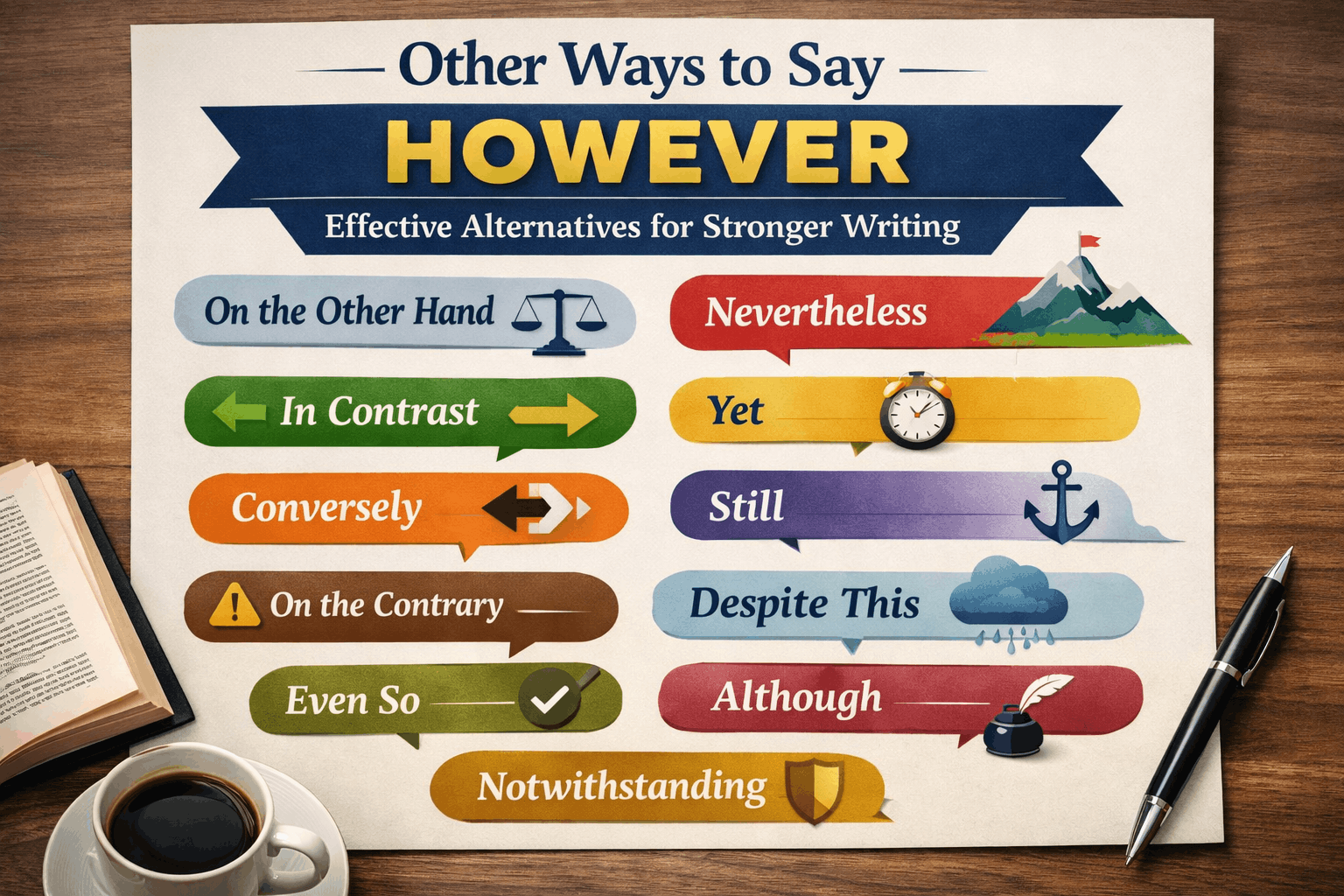
Here are some other ways to say “however”
If you’re looking for other ways to say however, the best choice depends on where the word sits in the sentence, how formal the piece is, and how much opposition you want to show. Some options work like however in the middle of a sentence. Others belong at the start of a clause. A few are old-fashioned, though they still appear in polished prose.
Quick answers: what is a better word for “however”?
The shortest answer is but. It’s the most natural replacement in everyday English, and it often sounds cleaner than however in plain sentences. If you want something a little more formal, try nevertheless, nonetheless, or notwithstanding. If you’re writing casually, still, yet, or anyhow may fit better.
Here’s the catch: not every replacement works in the same place. Some are conjunctive adverbs, which usually need a semicolon or a full stop before them. Others are subordinating conjunctions, which change the sentence structure. That’s why a quick list of synonyms isn’t enough.
Choose by sentence position first
Before swapping in a new word, look at the structure of the sentence. This is where many writers go wrong. They replace however with a word that sounds right but doesn’t fit the grammar. The result is awkward, or just plain wrong.
1. Sentence-start alternatives
These often open a new sentence or clause and show opposition clearly:
- Nevertheless works well in formal prose and often follows a full stop or semicolon.
- Nonetheless behaves almost the same way, though it can sound a touch smoother in business prose.
- Still is shorter and more conversational.
- Yet can start a sentence or join two clauses, depending on the structure.
Example: The survey results were mixed. Nevertheless, the team moved ahead with the rollout.
2. Mid-sentence alternatives
When you want to connect two complete clauses, punctuation matters. However is often set off with commas, while but usually joins clauses directly. On the other hand and conversely also work here, though they carry a slightly more analytical feel.
Example: The proposal was well researched, but it ignored the budget limit.
3. Clause-linked alternatives
Words like although, despite, and regardless don’t replace however sentence-for-sentence. They change the grammar. Instead of two independent clauses, they usually introduce a dependent clause. That means you can’t always swap them in without adjusting the sentence.
Example: Although the launch was delayed, customer interest stayed high.
What is a better word for “however” in professional writing?
In professional English, the best choice is usually the one that sounds precise rather than fancy. For emails, reports, and client updates, but is often enough. In more formal contexts, nevertheless, nonetheless, and notwithstanding are strong options. Per contra is much rarer and belongs mostly in legal or highly formal prose.
If you’re drafting for a manager, a client, or a journal, ask yourself one simple question: do I want a smooth turn, or a stronger, more deliberate one? That answer usually decides the word.
| Alternative | Part of speech / type | Best placement | Formality | Best use |
|---|---|---|---|---|
| but | coordinating conjunction | between clauses | neutral | fast, everyday reversal |
| however | conjunctive adverb | start, mid-sentence, or after a semicolon | neutral to formal | general opposition in clear prose |
| nevertheless / nonetheless | conjunctive adverb | sentence start or after a semicolon | formal | stronger opposition, polished tone |
| although / despite | subordinating conjunction / preposition | clause start | neutral to formal | subordinate opposition inside one sentence |
| still / yet / anyhow | adverb / discourse marker | sentence start or informal link | casual | lighter, less formal prose |
Formal alternatives to however, with grammar notes
Professional prose asks for control. It doesn’t need drama. It needs the right level of opposition, and it needs punctuation that doesn’t get in the way.
Nevertheless
Nevertheless is a conjunctive adverb. It usually introduces a second sentence or follows a semicolon. It sounds more deliberate than however and often feels slightly stronger. Use it when the second idea pushes back against the first, though you still want a restrained tone.
Use it: The draft had several weak sections. Nevertheless, the core argument held up.
Avoid it: In a casual blog post, it may sound stiff. In short notes, it can feel too formal for no good reason.
Nonetheless
Nonetheless is close to nevertheless, and in many cases the two are interchangeable. It’s also a conjunctive adverb. The difference is mostly in feel. Nonetheless can sound a little lighter and more current, which is why it often appears in business prose.
Use it: The timeline was tight. Nonetheless, the client approved the revised plan.
Don’t force it: If the opposition is small or routine, plain but may read better.
Notwithstanding
Notwithstanding is more formal than however, and it can work as either a preposition or a conjunctive adverb depending on context. In ordinary editing, it can feel heavy. In legal, policy, or scholarly prose, though, it sometimes fits perfectly because it signals a firm opposition without sounding chatty.
Use it: Notwithstanding the objections raised in review, the committee accepted the revised methodology.
Watch out: It’s not the best choice for everyday prose. If your sentence doesn’t already sound formal, notwithstanding may stick out.
Per contra and howbeit
Per contra is a Latin phrase that means, roughly, “on the contrary.” It appears in legal or scholarly prose, but outside those settings it can sound antique. Howbeit is also old-fashioned. You’ll still see it in literary or historical text, but modern readers rarely use it in everyday English.
These forms can be useful if you’re drafting a stylized passage or quoting older material. Otherwise, simpler choices are usually better.
Casual options that sound more natural in everyday English
If your draft sounds too stiff, the fix is often surprisingly simple. Drop the formal connector. Use something shorter. Sometimes even a plain but does more work than a polished alternative.
- But: the cleanest everyday choice. It joins two clauses directly and rarely feels stuffy.
- Still: useful when you want a softer turn, almost like “even so.”
- Yet: good for brief, sharp opposition.
- Anyhow: informal, slightly old-fashioned in speech, and common in relaxed prose.
- All the same: helpful when you want to acknowledge the first point before moving against it.
- Just the same: close to all the same, with a more conversational feel.
Example in a blog paragraph: The gear list looked complete, but the trip still felt underplanned. The route map was solid. Still, nobody had checked the weather beyond Friday, and that mattered more than anyone wanted to admit.
Example in speechy copy: We knew the odds were low. Anyhow, we sent the pitch. All the same, we expected a polite no. Just the same, the reply came back faster than expected.
How else to say “however” in an essay?
In an essay, the best replacement depends on what the sentence is doing. If you’re joining two independent clauses, however, nevertheless, and nonetheless all work well. If you want to fold the opposition into one clause, use although, despite, or regardless of instead.
That shift matters. A sentence that starts with although is not just a stylistic swap. It changes the grammar, and sometimes the emphasis too. The opposition becomes part of the clause instead of a separate logical step.
Essay-ready replacements with placement guidance
- However at the start of a new sentence: good for clear argument shifts.
- Nevertheless after a full stop: useful when you want a more formal essay tone.
- Although at the start of a dependent clause: best when the opposition belongs inside one sentence.
- Despite before a noun phrase: effective when you want compact scholarly wording.
- Regardless when the point is meant to hold true no matter what came before.
Here’s a simple example of how the structure changes:
Original: The theory is persuasive. However, the sample size is small.
Revised for an essay: The theory is persuasive, but the sample size is small.
Revised for a more formal essay style: The theory is persuasive. Nevertheless, the sample size is small.
Revised with a different structure: Although the theory is persuasive, the sample size is small.
Academic ways of saying however
Scholarly prose usually prefers precision over flair. That’s why writers often reach for nevertheless, nonetheless, notwithstanding, or a carefully placed but. Each one works a little differently, and each one can shift the tone of the paragraph.
Nevertheless and nonetheless are especially common in analytical prose because they signal concession cleanly. Notwithstanding sounds more formal and can feel heavy if used too often. Conversely is best when the second point is the opposite of the first, not just a mild reversal. And after all often introduces a reason that explains why the earlier statement still makes sense.
Example from an academic paragraph:
The intervention showed modest gains in the first month. Nevertheless, the effect weakened over time, suggesting that the treatment may need reinforcement. Conversely, participants who received follow-up support maintained higher scores throughout the study.
That paragraph does more than replace however. It shows opposition, reversal, and explanation in different places. That’s the real skill.
Opposition words are not all interchangeable
Writers often treat however, nevertheless, and although as if they mean the same thing. They don’t. Some are sentence adverbs. Some are conjunctions. Some introduce a phrase, while others connect two full clauses. If you ignore that difference, your sentence structure starts to wobble.
- However usually links two independent clauses or begins a new sentence.
- But is shorter and more direct, and it usually sits between clauses.
- Although changes the grammar by introducing a dependent clause.
- Despite is followed by a noun phrase, not a full clause.
- Regardless and regardless of can show that the second point still stands.
Example of a wrong swap: Although, the results were mixed. That doesn’t work because although needs a clause after it. A correct version would be: Although the results were mixed, the client approved the report.
Another common slip is punctuation. However often needs a comma when it starts a sentence, and it usually needs a semicolon if it sits between two complete clauses. But does not follow the same pattern. So don’t treat them like twins.
Before-and-after examples from real prose contexts
Generic examples help a little. Real paragraphs help more. The point is to see how the transition works across sentences, not just inside a single line.
Business example
Before: The client liked the first draft. However, they wanted the opening to sound less formal. However, they also asked for a shorter conclusion.
After: The client liked the first draft. Nevertheless, they wanted the opening to sound less formal. They also asked for a shorter conclusion. All the same, they were pleased with the overall direction.
The rewrite does two things. It cuts repetition, and it gives each opposition a slightly different weight.
Blog example
Before: The recipe is simple. However, it takes time to chill. However, the final texture is worth the wait.
After: The recipe is simple, but it does take time to chill. Still, the final texture is worth the wait, and that’s why I keep making it.
Notice how the second version sounds more natural. It doesn’t repeat the same hinge word over and over.
Academic example
Before: The sample showed a clear trend. However, the study design limits how far we can generalize the findings.
After: The sample showed a clear trend. Nonetheless, the study design limits how far we can generalize the findings.
In scholarly prose, that kind of shift is often enough. You don’t need to keep explaining the same thing twice.
A simple decision framework for choosing the right alternative
If you want a practical method, use this order:
- Check the grammar. Do you need a full clause, a dependent clause, or just a clause joiner?
- Check the tone. Is the piece formal, neutral, or casual?
- Check the strength of opposition. Is this a mild turn, or a real counterpoint?
- Check the position. Can the word sit at the start, or does it need to live in the middle?
- Check the rhythm. Does the sentence feel choppy, or does the new word smooth it out?
This sounds basic, but it saves time. A lot of writers start with the word they like and then try to build the sentence around it. That’s backwards. Build the sentence first, then pick the connector that fits.
Common mistakes when replacing however
There are a few patterns worth watching for. They come up a lot, especially in edited drafts from non-native speakers and busy professionals who are trying to polish their prose quickly.
- Using although in place of however without changing the clause structure.
- Dropping a comma where one is needed after however or nevertheless.
- Choosing a formal word like notwithstanding in a casual paragraph where it feels inflated.
- Repeating the same opposition marker in every sentence, which makes the prose sound mechanical.
- Using but when the sentence really needs a stronger concession such as all the same or nonetheless.
If the prose sounds flat, the problem usually isn’t just the word however. It’s the pattern. Vary the structure, not only the synonym.
One last set of practical examples
These sample lines show how different choices shift tone and structure. They’re short on purpose.
- However: The data were promising; however, the margin of error stayed high.
- But: The data were promising, but the margin of error stayed high.
- Nevertheless: The data were promising. Nevertheless, the margin of error stayed high.
- Although: Although the data were promising, the margin of error stayed high.
- Despite: Despite the promising data, the margin of error stayed high.
- Anyhow: The plan changed twice. Anyhow, we made the deadline.
- Withal: He was exhausted, withal calm, a word choice that now feels literary rather than everyday.
That last one deserves a note. Withal is real English, but it’s old-fashioned and rare. You’ll mostly see it in historical prose or in passages aiming for an archaic tone. Same with howbeit. Interesting words. Not always useful words.
If your goal is clean modern prose, the safest choices are usually but, however, nevertheless, nonetheless, and although. The rest are there when tone, genre, or precision calls for them.
And if you only remember one thing, make it this: the best replacement isn’t the one that sounds most formal. It’s the one that keeps the sentence doing its job without drawing attention to itself. For more clarity, use example sentences to test the flow, and lean on definition-level precision when the choice feels close.