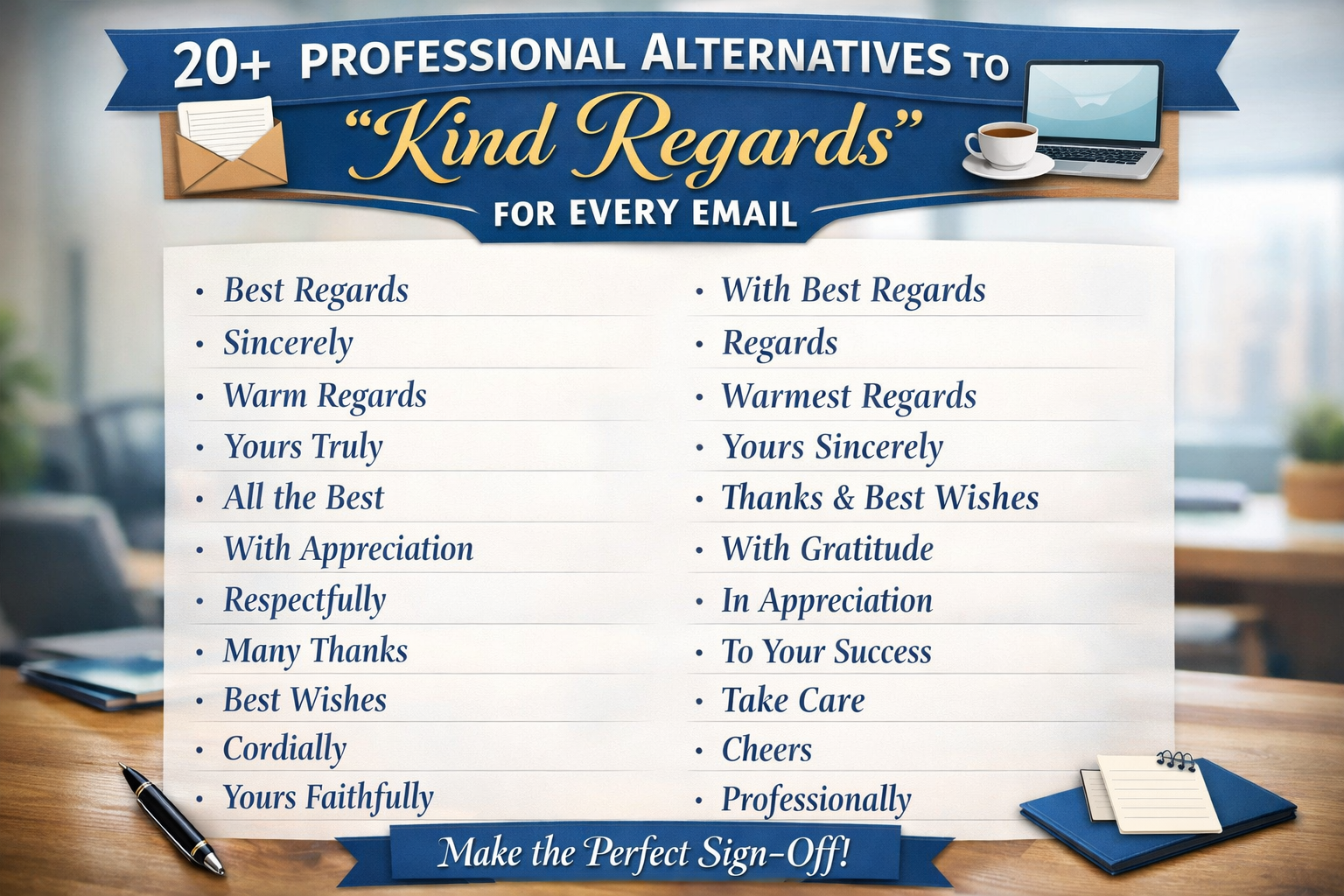
20+ Professional Alternatives to Kind Regards for Every Email
Signing off an email feels like such a small detail — until you realize you’ve used the same closing phrase in every single note you’ve sent this week. While it’s a polite and well-regarded sign off, repeating it over and over can make your correspondence feel robotic or cold. The way you close a letter leaves a lasting impression, and choosing the right phrase can set the right tone, build stronger bonds, and show your personality.
Whether you’re sending a job application, following up with a client, or reaching out to a new colleague, your closing deserves just as much thought as your opening line. English offers a wide range of regards options — formal, friendly, warm, and everything in between. This guide covers more than 20 choices, explains when to use each one, and helps you match your sign off to your correspondence like a pro.
Why Your Email Sign-Off Actually Matters
Your closing phrase is the last thing a reader sees before they decide whether to reply, act, or move on. In corporate correspondence, that final moment shapes the feeling you leave behind. A sign off that feels too stiff can hurt a warm, casual note. One that’s too relaxed can damage your credibility.
Getting the balance right helps your reader feel respected and valued — and makes a positive reply more likely. Knowing the full range from formal to informal is the first step toward better writing habits.
How Do You Say Kind Regards in Another Way? (And How Do You Choose?)
The right choice depends on three things: your bond with the reader, the tone of your correspondence, and the culture or field you’re writing in. “Kind regards” has a British and Commonwealth feel — it’s warm but measured, polished but not stiff. Best regards is widely seen as the closest global match and the safest swap in almost any context.
A simple test: read your whole letter out loud. If the closing feels out of place, swap it for something that fits the tone better. Here’s how to think about the main factors:
-
Your relationship with the recipient: The closer the relationship, the more casual you can be. A long-term client warrants more warmth than a first contact.
-
The tone of your correspondence: Your closing should match the energy of the rest of your writing. A formal complaint letter shouldn’t end with “Cheers.”
-
Industry and company culture: Creative, tech, and startup environments tend to embrace casual communication. Legal, finance, and government sectors lean toward formality.
One thing the formality scale doesn’t cover: email threads. If you’re on the 10th reply in a back-and-forth chain, signing off with “Yours sincerely” feels oddly stiff. After the first two or three exchanges, it’s fine — and often better — to drop to “Best,” “Thanks,” or no sign off at all. This shows comfort and ease rather than rudeness. Matching your closing to the rhythm of the chat is a sign of real communication skill.
Formal and Professional Alternatives to Kind Regards
These options work well in corporate letters, legal correspondence, job applications, or first-time notes to senior staff. If you want to say regards in a polite, formal way, these are your best choices.
Sincerely / Yours Sincerely / Sincerely Yours
“Sincerely” is the standard in American English — clean, respectful, and widely known. It fits well in cover letters, business proposals, and any correspondence where you want to come across as genuine. “Yours sincerely” is the classic British version, used when you know the reader’s name. “Sincerely yours” adds a subtle touch and is common in American business letters.
“Yours faithfully,” by contrast, is the go-to in British formal letters when you don’t know the reader’s name — for instance, when writing “Dear Sir or Madam.” Note that this phrase sounds old-fashioned in American contexts, so avoid it when writing to US-based contacts.
Examples: “Sincerely, Robert Nguyen” / “Yours sincerely, James Hartley” / “Yours faithfully, Maria Connell”
Best Regards Alternatives and Its Variations
“Best regards” is arguably the closest match to “Kind regards” and the best global neutral. It’s safe, polished, and fits nearly every field and culture — making it the top pick when you’re not sure. It’s slightly warmer than “Kind regards” while keeping the same level of polish. Exploring best regards alternatives can help you find the right tone for each situation.
“With regards” and “With kind regards” are close options. Both stay formal and flow well in corporate settings. Use them when you want a small change from your usual phrase without shifting the tone.
Examples: “Best regards, Sarah Thompson” / “With kind regards, Amanda Blythe”
“Respectfully” and “Respectfully yours” show deep respect and work well when writing to people in power — government officials, executives, or academic leaders. Save these for high-stakes correspondence where humility and a polished tone both matter.
Semi-Formal Alternatives: Warm but Still Polished
These options strike a balance between polish and warmth. They work well with colleagues you’ve written to before, clients you know well, or in fields with a more relaxed culture.
“Warm regards” is a great choice when you want to show genuine care. It’s slightly more heartfelt than “Kind regards” and works well in follow-up notes, thank you letters, or correspondence with long-term clients. “Warmly” is the shorter version — more and more popular in modern workplace writing, especially in networking and mentoring contexts.
“Best wishes” is one of the most flexible sign offs around. It shows goodwill without tipping into casual territory and fits well in upbeat correspondence — such as notes of praise, project updates, or letters where good wishes feel natural. “All the best” carries a similar feel and is especially common in the UK and Australia.
When someone has helped you, two closings stand out — and they’re worth telling apart. “With appreciation” reads as measured and formal, suited to structured thank you notes or vendor correspondence. “With gratitude” feels slightly more heartfelt, making it the better fit for sincere thank you letters, post-interview follow-ups, or notes to mentors. Choose based on how meaningful the gesture was.
“Many thanks” is short and friendly — especially common in British workplace correspondence when making a request. “Thanks in advance” works when you’re asking for something and want to show thanks ahead of time, though use it sparingly if the request is large or complex. “Looking forward to hearing from you” doubles as a gentle call to action and works well in proposals or any note where you’re waiting on a reply.
Casual and Informal Alternatives
For colleagues you know well, close contacts, or internal notes in relaxed work cultures, these casual closings feel more natural than a stiff sign off. If you’re wondering what else to say besides kind regards in a friendly context, these are your options.
“Best” is the minimalist’s dream — short, appropriate for most contexts, and widely adopted in fast-paced settings. “Thanks” is warm, quick, and one of the most natural closings in everyday workplace correspondence. Avoid both in very formal contexts or first notes to senior contacts.
“Take care” adds a human touch and works well with colleagues you genuinely like or clients you’ve built a strong bond with. “Cheers” is popular in British, Australian, and New Zealand work culture — but be careful in North American corporate settings, where it can feel too casual or even flippant. “Have a great day” adds positive energy and works well in service-based fields.
“Warmest wishes” sits at the warmer end of the casual range — it’s caring without being inappropriate and works well in client notes where a real bond has grown.
Regional Differences to Be Aware Of
Sign-off norms vary more than most people think, and getting this wrong can send the wrong signal — especially in global correspondence.
-
UK and Commonwealth: “Kind regards,” “Best regards,” “Yours sincerely,” and “Yours faithfully” are all standard and well-received. A casual sign off like “Cheers” is fine in relaxed contexts. “Kind regards” itself is most at home here.
-
United States: “Sincerely” and “Best regards” are the main formal closings. “Yours faithfully” sounds old-fashioned and is rarely seen. “Kind regards” is understood but can feel slightly formal or British in tone. “Cheers” may seem odd in traditional corporate settings.
-
Australia and New Zealand: Communication tends to be warmer and less formal. “All the best,” a quick “Cheers,” and “Thanks” are widely accepted even in polished correspondence. “Yours faithfully” would feel out of place in most contexts.
-
Global/International: When you’re unsure of your reader’s background, “Best regards” is the safest neutral. It’s polished, warm, and known across nearly every English-speaking market.
Industry-Specific Conventions Worth Knowing
Beyond culture, your field shapes what’s right. A few quick tips:
-
In legal correspondence, “Yours faithfully” and “Yours sincerely” carry traditional weight and are often expected. Casual closings like “Thanks” are not right in formal legal letters.
-
In academic emails, “Best regards” and “Kind regards” remain standard even between peers — avoid overly casual options unless you have a well-established relationship.
-
In healthcare, “Regards” or “Best regards” keeps the right formal distance in workplace correspondence.
-
In creative and tech industries, casual closings like “Best,” “Thanks,” or even a breezy sign off are widely accepted and often preferred.
Quick Reference: Regards Alternatives at a Glance
Here’s a table to help you pick the right closing for any situation. Your signature should always follow whichever option you choose.
|
Sign-Off |
Formality Level |
Best Used When |
|---|---|---|
|
Yours sincerely / Yours faithfully |
Very formal |
Official letters, job applications (UK/Commonwealth) |
|
Sincerely / Sincerely yours |
Very formal |
Cover letters, formal emails (US context) |
|
Respectfully / Respectfully yours |
Very formal |
Writing to authority figures, government, executives |
|
Best regards |
Professional |
Almost any professional email — safe global neutral |
|
Kind regards / With kind regards |
Professional |
Business correspondence, first contact (UK/Commonwealth) |
|
Warm regards / Warmly |
Semi-formal |
Established relationships, follow-ups, networking |
|
Best wishes / All the best |
Semi-formal |
Positive news, congratulations, ongoing relationships |
|
With gratitude / With appreciation |
Semi-formal |
Thank-you emails, post-interview follow-ups |
|
Many thanks / Thanks in advance |
Semi-formal |
Making requests, following up on tasks |
|
Best / Thanks |
Informal |
Internal emails, ongoing threads, familiar contacts |
|
Cheers / Take care |
Casual |
Close colleagues, UK/AU/NZ contexts, relaxed cultures |
|
Have a great day / Until next time |
Casual |
Service industries, ongoing client relationships |
Common Sign-Off Mistakes to Avoid
Picking a great option is only half the battle. Avoid these mistakes that can hurt an otherwise well-crafted note:
-
Using no sign off at all: Ending a letter with no closing phrase can come across as rude or rushed, especially in formal contexts or at the end of a first note to someone new.
-
Overusing a single phrase: If you’re sending correspondence that always ends the same way, it starts to feel like a template. Rotate your closings to keep them feeling real.
-
Mismatching tone: A very formal letter body ending with “Cheers!” creates a jarring clash. Keep things consistent from the first line to the last.
-
Forgetting your name or signature: Always include your name — and a proper signature where needed — especially in first notes. Never assume the reader knows who you are from your address alone.
What Is the Warmest Way to End a Letter or Email?
If warmth is your goal, “Warmest wishes,” “Warm regards,” or “Warmly” are the strongest options in a polished context. For more intimate letters, “With love” or “With affection” work — but only where the bond truly calls for it. In client correspondence where you want to show genuine care, “Warm regards” hits the sweet spot: it’s heartfelt enough to seem human, yet composed enough to stay right. A well-chosen sign off here can make all the difference.
The warmest closing is the one that feels true to your bond with the reader. A heartfelt “Take care” from someone who means it lands warmer than a stock “Warmest wishes” from someone who doesn’t.
Final Thoughts
The perfect closing isn’t about finding one magic phrase and using it forever. It’s about knowing how to pick the right option for each reader and bond. “Kind regards” has served writers well for decades — but knowing when and how to vary your sign off is a mark of real communication skill.
Whether you go with the timeless formality of “Yours sincerely,” the global safety of “Best regards,” the warmth of “Warmly,” or the quick ease of “Best,” you now have a full set of best regards alternatives to draw from. If you’re still unsure which fits, read the letter aloud — you’re likely to hear immediately if the tone is off. Your correspondence will feel more thoughtful and more effective — one closing at a time. And if you’re ever in doubt, a simple thank you as part of your sign off is almost always welcome.